
- Author
- Editorial Team
- Published
- Reading time
- 11 min read
Teen Patti is the card game most Pakistani players already know from family gatherings, so it is natural to look for it inside Mil Win. People search for it as "mil win teen patti", "milwin 3 patti" or simply "mil win card game", and the answer to all three is the same: a Teen Patti-style table may appear in the card games section, and the version you find there is the one that counts.
This guide explains the traditional game — the boot, blind and seen play, chaal, show and side show — then gives you the full hand ranking with approximate odds, the variants platforms often add, and a bankroll rule written specifically for card tables. It also tells you plainly what no "Mil Win Teen Patti tips" video will: the game is chance plus a few limited decisions, and there is no sure-win trick. You may see it searched as "milwin teen patti", "teen patti mil win", "mil win 3 patti" or "mil win teen patti game"; "teen patti real cash Pakistan" searches also land on tables like this.
How does Mil Win Teen Patti work?
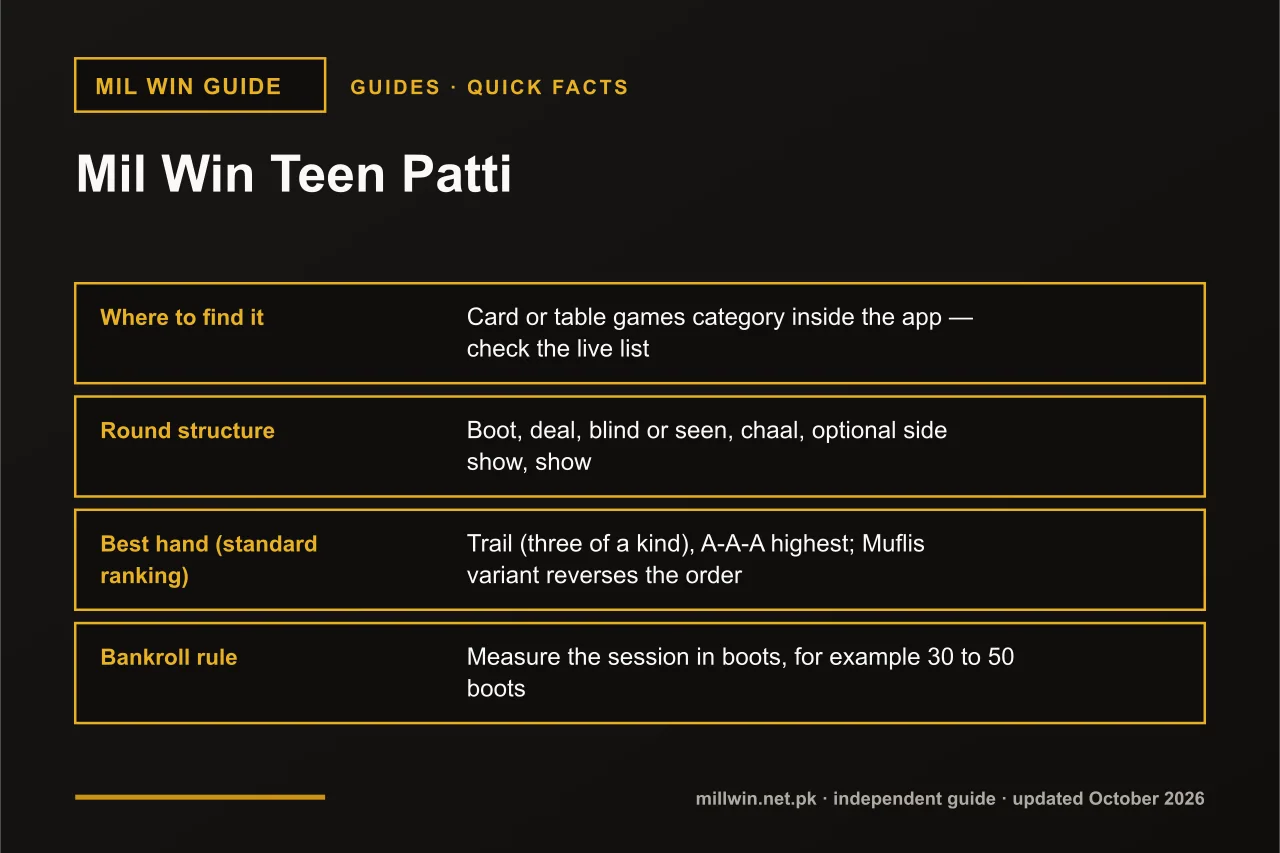
Mil Win Teen Patti, where a table is live in the card games section, follows the traditional three-card game: every player pays a boot, receives three cards, plays blind or seen, then bets in chaal rounds until a show between the last two players. A trail is the best hand and roughly three in four hands are a high card.
| Quick fact | Detail |
|---|---|
| Where to find it | Card or table games category inside the app — check the live list |
| Round structure | Boot, deal, blind or seen, chaal, optional side show, show |
| Best hand (standard ranking) | Trail (three of a kind), A-A-A highest; Muflis variant reverses the order |
| Bankroll rule | Measure the session in boots, for example 30 to 50 boots |
| Last updated | 10 October 2026 |
Key Takeaways
- Mil Win Teen Patti availability changes, so check the card games category in the app rather than trusting third-party game lists.
- In standard Teen Patti ranking a trail beats pure sequence, sequence, colour, pair and high card, in that order.
- About three in four Teen Patti hands are only a high card, which makes a pair a strong hand at most tables.
- Measure a Mil Win Teen Patti bankroll in boots, set stop points before the first hand, and ignore every sure-win trick.
Is Teen Patti Available on Mil Win?
Game lists on platforms like Mil Win change, and third-party sites often list titles that are no longer live. The honest answer is: open the app, go to the card or table games category and look. If a Teen Patti, 3 Patti or similar three-card table is there, tap into its rules screen before placing anything.
What you will probably find is one of two formats. A multiplayer table seats real players against each other with the platform taking a small cut. A dealer-style table has you playing against the house with fixed payouts for each hand. Both are discussed below because the strategy and the risk are different. For the wider list of categories and how they are organised, the games guide is the starting point.
Open the Mil Win games guide →
How Teen Patti Works: The Basics of a Round
Teen Patti means "three cards" and is sometimes called Indian or Pakistani three-card poker — which is why "mil win poker" searches usually land on the same table. A standard 52-card deck is used with no jokers in the base game. Aces are high, and the hand that ranks higher wins the pot. A typical round in the traditional game runs like this:
- Boot — every player puts the agreed minimum stake into the pot before cards are dealt. This is the table's entry price.
- Deal — each player receives three cards face down.
- Blind or seen — each player decides whether to play without looking at their cards (blind) or look first (seen). Seen players must usually bet double what a blind player bets.
- Chaal — betting goes around the table. Each player either matches or raises the current stake or folds (packs) and loses what they have put in.
- Side show — a seen player may ask the previous seen player to compare hands privately; the lower hand must fold. The other player can refuse.
- Show — when only two players remain, either can call for a show by paying the stake; both hands are revealed and the better hand takes the pot.
Online versions compress this with timers and buttons, and many add a maximum pot or a maximum number of blind rounds. Those caps are what make an online table feel faster and less forgiving than the family version.
Key Terms: Boot, Blind, Seen, Chaal, Show and Side Show
- Boot (or ante) — the forced minimum stake every player pays before the deal; the pot never starts at zero.
- Blind — playing without looking at your cards; you bet at the lower rate but you are acting on no information.
- Seen (chaal player) — you have looked at your cards and must bet at the higher rate, usually twice the blind stake.
- Chaal — the act of continuing in the hand by matching or raising the current stake.
- Pack / fold — leaving the hand and forfeiting what you have already put in.
- Side show — a private comparison between two seen players; the loser folds, the winner stays.
- Show — the final reveal between the last two players; it costs the current stake to call.
- Pot limit — an online cap on the total pot that forces a show automatically once reached.
Teen Patti Hand Rankings (With Approximate Odds)
The ranking below is the traditional order and matches most online tables. Note that, unlike five-card poker, a pure sequence (straight flush) beats a trail in some house rules — but in the standard Teen Patti ranking, trail is highest. Check the in-app rule sheet for the version you are playing. The probabilities are standard figures for three cards from a 52-card deck and are labelled approximate because variants with jokers change them.
| Rank | Hand | What it is | Approximate chance |
|---|---|---|---|
| 1 | Trail (set / trio) | Three cards of the same rank, e.g. K-K-K; A-A-A is the best hand | About 0.24% (roughly 1 in 425) |
| 2 | Pure sequence (straight flush) | Three consecutive cards of the same suit, e.g. 9-10-J of hearts | About 0.22% (roughly 1 in 460) |
| 3 | Sequence (run / straight) | Three consecutive cards of mixed suits, e.g. 4-5-6 | About 3.3% (roughly 1 in 31) |
| 4 | Colour (flush) | Three cards of the same suit that are not in sequence | About 5.0% (roughly 1 in 20) |
| 5 | Pair | Two cards of the same rank plus one other; higher pair wins, then the third card | About 16.9% (roughly 1 in 6) |
| 6 | High card | None of the above; the highest card decides, then the next | About 74.4% (roughly 3 in 4) |
Three out of four hands dealt are nothing but a high card. That single fact explains most of the strategy: the player who understands that a pair is already a strong hand, and that a show against a seen opponent who keeps raising is usually losing, will outlast the player who treats every hand as a potential trail.
Teen Patti Variants Platforms Often Offer
Online card rooms rarely stop at the classic game. Whether Mil Win offers any of these is for the app to show you, but these three are so common that you should recognise them on sight:
- Joker — one or more cards are declared wild (either a dealt joker or a randomly chosen rank) and can stand in for any card. Trails and sequences become far more common, so the ranking table's odds no longer apply.
- AK47 — all Aces, Kings, Fours and Sevens are wild. With sixteen wild cards in the deck, strong hands are routine and the game becomes a question of who holds the best of several good hands.
- Muflis (Lowball) — the ranking is reversed: the worst traditional hand wins. A high card of 2-3-5 of mixed suits is the best possible hand, and a trail is the worst.
The practical point is that a variant changes what a "good hand" means. Sitting down at a Muflis table with classic instincts is an expensive way to learn the difference. Always read the variant name on the table before the first boot leaves your balance.
Dealer-Style Tables vs Player Tables
A player table is the traditional format: you and other users share one pot and the platform takes a percentage. Your result depends on your cards and on the other players' decisions, which is where bluffing, blind play and reading betting patterns come in.
A dealer-style table — often found in the casino or live section — pits you against the house. You place a bet, both hands are dealt, and a fixed paytable decides what you win for each hand. There is no bluffing and no one to read; the only decisions are how much to bet and, sometimes, whether to play or fold after seeing your cards. Dealer tables are simpler, faster and have a built-in house edge in the paytable, so the long-run expectation is set before you sit down.
Read the Mil Win casino guide →
Bankroll Rules for Card Tables: Think in Boots, Not Rupees
Slots and crash games take a fixed bet per round. Teen Patti does not — a single hand can cost one boot if you fold early or many boots if you chaal to a show. That is why a card-table bankroll should be measured in boots, not in PKR.
A practical rule: before sitting down, decide how many boots your session is worth and never bring more than that to the table. Many experienced players use a session bankroll of boot × 30 to boot × 50 as a reference point — not because the number is magic, but because it survives a normal run of bad hands without forcing you to leave after three folds. If the table's boot is higher than your session budget divided by 30, the table is too big for your budget, not the other way round.
- Set a stop-loss in boots (for example, leave at minus 20 boots) and a stop-win (for example, bank the profit at plus 15 boots).
- Never raise your session budget mid-game to "get back" a lost show.
- Deposit only what the session needs; keep the rest in your wallet, where it cannot be chaaled away in frustration.
- Remember the game is for adults 18+ and losses are a normal, expected outcome — not a signal to continue.
See how Mil Win deposits are processed →
Common Mistakes at the Teen Patti Table
Most of the money lost at a Teen Patti table is lost to habits, not to bad cards. These are the ones that appear in almost every session:
- Playing blind too long — blind play is cheaper per round, but every round you stay blind you are matching bets with no information while seen players raise against you. Look after one or two rounds unless the table rules reward blind play.
- Chasing a show — calling a show because you have already put a lot into the pot, not because your hand justifies it. The money in the pot is no longer yours; only the next decision is.
- Treating a pair as weak — against three or more players a pair is often the best hand at the table. Folding it to a single raise is giving away value.
- Ignoring the variant — playing classic instincts on a Joker, AK47 or Muflis table.
- Raising on tilt — doubling the stake after a lost show to "recover". This is the single fastest way to burn a session bankroll.
- Sitting at a boot level above your budget — the table decides the pace; if the boot is too high you will be short-stacked and forced into bad shows.
See what a so-called Mil Win hack really does →
Sensible Mil Win Teen Patti Tips (The Realistic Kind)
If "tips" means decisions that lose less rather than a way to win, here is the realistic list. Start at the lowest boot available so the learning is cheap. Watch a few hands before joining to see how aggressive the table is. Look at your cards early, fold high-card hands against raises, and value a pair properly. Use a side show when the rules allow it and you are reasonably confident; refuse one when you are not.
Above all, decide your stop points before the first boot and leave when you hit either one. Players new to the app should also run through the general first-session steps — budget, time limit and a low-stake game — before choosing a card table at all.
See how a first Mil Win session works →
Teen Patti for Real Cash in Pakistan: Keep It Under Control
Teen Patti for real cash feels different from the family game because every chaal is PKR leaving a JazzCash or Easypaisa wallet, and the timer removes the pauses that normally let you think. That combination is why card tables can take a session budget faster than almost any other game type in the app.
Use the same tools you would for any real-money game: a budget set before you open the app, a time limit, no play when tired or upset, and no borrowing to play. If you find yourself raising to recover a loss, that is the moment to close the table — and the responsible gaming guide has practical ways to make that easier.
See the tools for keeping play under control →
See how slot games work on Mil Win →
Read why Milwin, Millwin and Melvin Game point to one app →
See the most common Mil Win questions answered →
Conclusion
Mil Win Teen Patti — if a table is live in the app when you look — is the three-card game you already know, compressed by timers and pot caps. Learn the hand ranking well enough that you know a pair is strong, measure your bankroll in boots, read the variant name before the first boot, and treat every "sure-win trick" as the scam it is.
The rules inside the app always win over any guide, including this one. Use this page to understand the rule sheet, then let the rule sheet decide how you play.
Frequently Asked Questions
Does Mil Win have Teen Patti?
A Teen Patti-style table may appear in the card games section of the app, but game lists change and third-party sites often list titles that are not currently live. Open the app and check the card or table category; the variant and rules shown there are the ones that apply.
What is the best hand in Mil Win Teen Patti?
In standard ranking, a trail (three of a kind) is the best hand, with A-A-A the highest trail. Pure sequence, sequence, colour, pair and high card follow in that order. Variants such as Muflis reverse the ranking, so confirm which version the table is running.
What does blind mean in 3 Patti?
Playing blind means betting without looking at your cards. Blind players bet at a lower rate than seen players, usually half, but they are acting on no information. Staying blind for many rounds while seen players raise is a common way to lose a pot.
Is there a trick to win Mil Win Teen Patti?
No. The cards are dealt at random and no app, prediction tool or paid tip can see the next hand. The only things you control are which hands you continue with, how much you stake and when you leave. Anything sold as a guaranteed trick or a card-revealing MOD APK is a scam.
How much should I bring to a Teen Patti table?
Measure it in boots, not rupees. A common reference is a session bankroll of around 30 to 50 boots, with a stop-loss and stop-win set in advance. If the table's boot is more than your session budget divided by 30, choose a smaller table.
Is Teen Patti for real cash legal in Pakistan?
The legal position of real-money gaming in Pakistan is complex and can change. We are an independent guide and do not give legal advice. Read the platform's own terms, make sure you are 18 or over, and treat any money you stake as money you can afford to lose.
Related reading
- Guides
 How to Play Mil Win Game – A First-Session Guide for Beginners
Guides · 8 min read
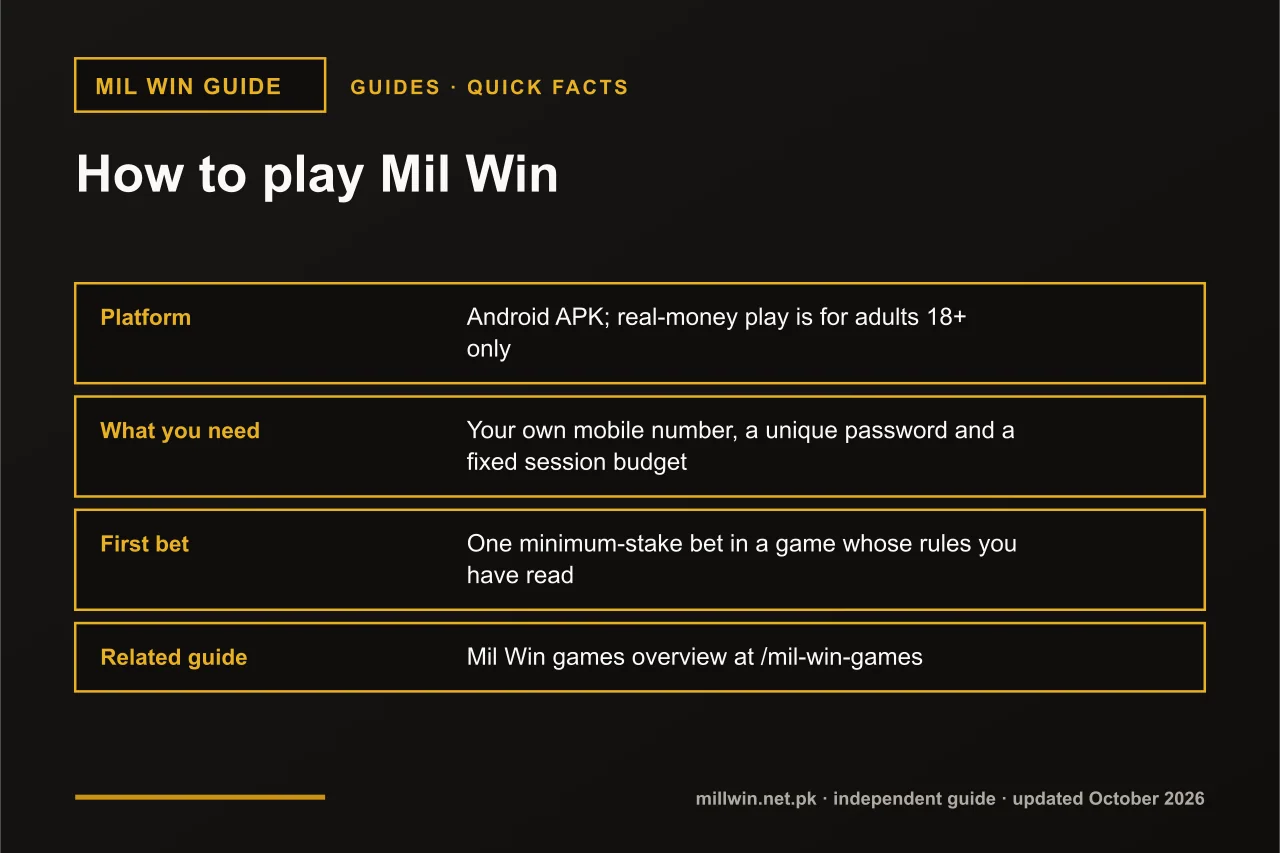
How to Play Mil Win Game – A First-Session Guide for Beginners
- Guides
 Mil Win New User Guide – 10 Mistakes to Avoid in 2026
Guides · 3 min read
Mil Win New User Guide – 10 Mistakes to Avoid in 2026
- Guides
 Mil Win Account Banned or Frozen? Causes, KYC and How to Appeal
Guides · 11 min read
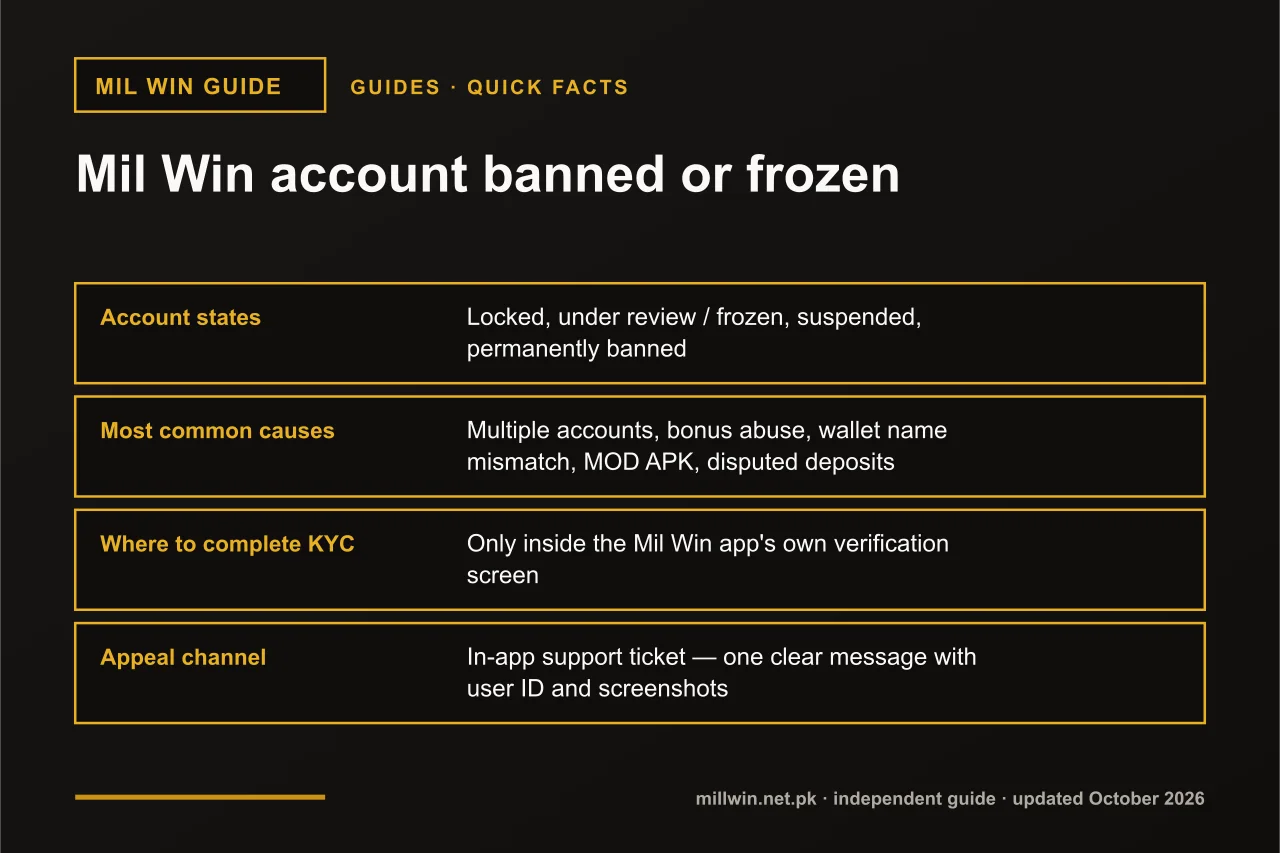
Mil Win Account Banned or Frozen? Causes, KYC and How to Appeal